Tuesday, 31 January 2017

Dust and Life - Psalm 119.25

My life is down in the dust; give me life through Your word. 119.25


When it comes to hard truths about life you won’t find any rose-tinting from the Bible.  There is no ‘spoon full of sugar to help the medicine go down.’  Right from the start God tells us that due to sin “you will eat bread by the sweat of your brow until you return to the ground, since you were taken from it. For you are dust, and you will return to dust” (Genesis 3.19).

God does not forget what we are: “For the Lord knows what we are made of, remembering that we are dust.  As for man, his days are like grass - he blooms like a flower in the field; when the wind passes over it, it vanishes, and its place is no longer known” (Psalm 103.14-16).  When our lives come to the appointed time for death we learn from Scripture that God Himself “turns people back to dust, saying, ‘return to dust, you mortals!” (Psalm 90.3 NLT)

Dust and ash in the Bible is the place of repentance, sorrow, grief, misery, and pain.  People who had lost everything would cover themselves in dust and ashes - in the stuff which represented death and the end of all things.  Maybe there have been times in your life where you have not only been ‘down in the dumps’ but ‘down in the dust.’  Times when everything seems to have been taken from you - even your integrity and pride.  Of late I have certainly been experiencing days like this so I can truly empathise with you (which I suspect is why the Lord has led me to this desert in the first place).

The Book of Psalms is full of songs from David and others who were despairing of their life and their very existence.  Some psalms are so dark and brooding they deserve an R rating for ‘likely to cause depression or severe mood swings.’  These psalms have been given to us by God because such darkness and gut-wrenching  despair is a valid human emotion, it is part of human experience - so much a part of it that Jesus had to go through it too if He were to ever truly redeem us.  Jesus became so distraught that he knelt down and cried out to God to take His pain away; Jesus’ cry was so all-consuming that He sweated drops of blood (a genuine medical condition called hematidrosis which is caused by extreme stress).  

When we reach the place of dust and it seems that our life is worthless we must look to God’s word for the map to the life we need.  When we open Scripture at such times the Lord points us to how Jesus suffered for us that we might be set free.  When we open the Scriptures at such times we see how through the ages great saints have entered just such times of darkness and yet God never abandoned them but rather lifted them up from the dust.  When we open the Scriptures we come face to face with a life which is not our own, a life given to us freely and which cannot be destroyed by the cares and worries of the world - a life which gives us such great worth and value in the eyes of God that He would literally die for us.   Let us always pray when we open our Bibles “Lord show me the life Jesus offers me and the truths that set me free.”  The Christian faith brings all of us to the dust of death - death to sin, death to our selfishness, death to our pride, death to our flesh - but by the same token only the Christian faith then promises resurrection and life in all its fullness!
Wednesday, 12 October 2016

BOOK Review - Free Grace Theology by Wayne Grudem

“Free Grace" Theology: 5 Ways it Diminishes the Gospel, Wayne Grudem, 2016, Crossway, 159 pages, £8.59 amazon, ISBN: 978-1-4335-5114-7


I purchased this book thinking that it was addressing the somewhat similar and perhaps adjacent ‘Hyper Grace Gospel.’  I am not convinced it does -  rather it criticises a movement far more insidious, dangerous, and frankly frightening. At times I was baffled by the teaching espoused by the ‘Free Grace Theology’ and saw it as not only biblically untenable but a terrible deceit which, as Grudem points out, threatens the eternal rest of many souls.  

Grudem begins by wanting to state that this book is to be seen as part of a discussion amongst friends.  This is something which he largely manages to maintain and indeed he is careful - and quite right - to hold back from using the term ‘heresy’ to describe what is nonetheless a dangerous teaching and twisting of the Good News.  At the core of this discussion is a disagreement over what is meant in the common Protestant refrain that we are saved by ‘faith alone.

The first chapter addresses the question of what the Reformers meant by this phrase and bluntly puts the case that all the Reformers believed that “we are saved by faith alone, but that faith is never alone.”  Grudem’s formulaic and academic method shines through and he gives extensive references as to why the Reformers did not teach what the Free Grace promoters allege.  His  illustration using a set of keys on page 37 was particular useful for the minister who wishes to explain this to those largely out of the academic loop.  

The following chapters consider why this correct understanding of ‘faith alone’ is so important. This is achieved by looking in consecutive chapters at repentance, assurance, and trust in the person of Christ. In each of these chapters Grudem systematically cuts through the arguments of the Free Grace authors with the efficiency of a world champion food slicer. With repeated and simple strokes he proceeds to undermine each and every point of contention with biblical, theological, and historical evidence.  Whilst impressive, it did actually become rather tiring and almost nauseating; having the same list of biblical passages repeated in full again and again and again - sometimes only pages apart - was perhaps overkill.  Indeed, that word ‘overkill’ came to find when considering the overall character of this book. It reads like Wayne Grudem has brought a Challenger Two Battle Tank to a knife fight.  

Perhaps what made the Free Grace Theology seem so repulsive to me was how the main authors promoting it were deceitful and disingenuous.  Time and again Grudem shows how they have quoted from prominent historic theologians or secular Greek manuals to demonstrate that their view is correct.  Grudem reveals these deceits for what they are - selective quotations ignoring wider context or co-text and clever editing.  I do not know whether these misrepresentations were somehow accidental or purposeful but either way it is deplorable.  As an Anglican I have seen all too well how such selective use of material and ‘clever’ editing can change whole denominations (many of the Ritualists of the 19th century were masters in this art) and I find it rather frightening that it is still occurring today.

One minor issue I had with the book was not with Grudem's work but rather the formatting of the footnotes (which were moderately extensive). This is most unlike Crossway and sadly was rather distracting in the end. Due to there being insufficient gap between the tiny superscript numbers and the actual footnote it became very difficult to quickly identify which note was to which number when dealing with a series of long footnotes.

Ultimately, this is a superb resource which seemingly blows Free Grace Theology not only out of the water but out of planetary orbit.  It is a great example of relentless academic rigour overpowering poor scholarship and emotional appeals.  On the down side it comes across on occasion as somewhat soulless, cold, and hard.  Sadly that is what the truth is like at times.


Friday, 7 October 2016

The Missing Comma in your BCP

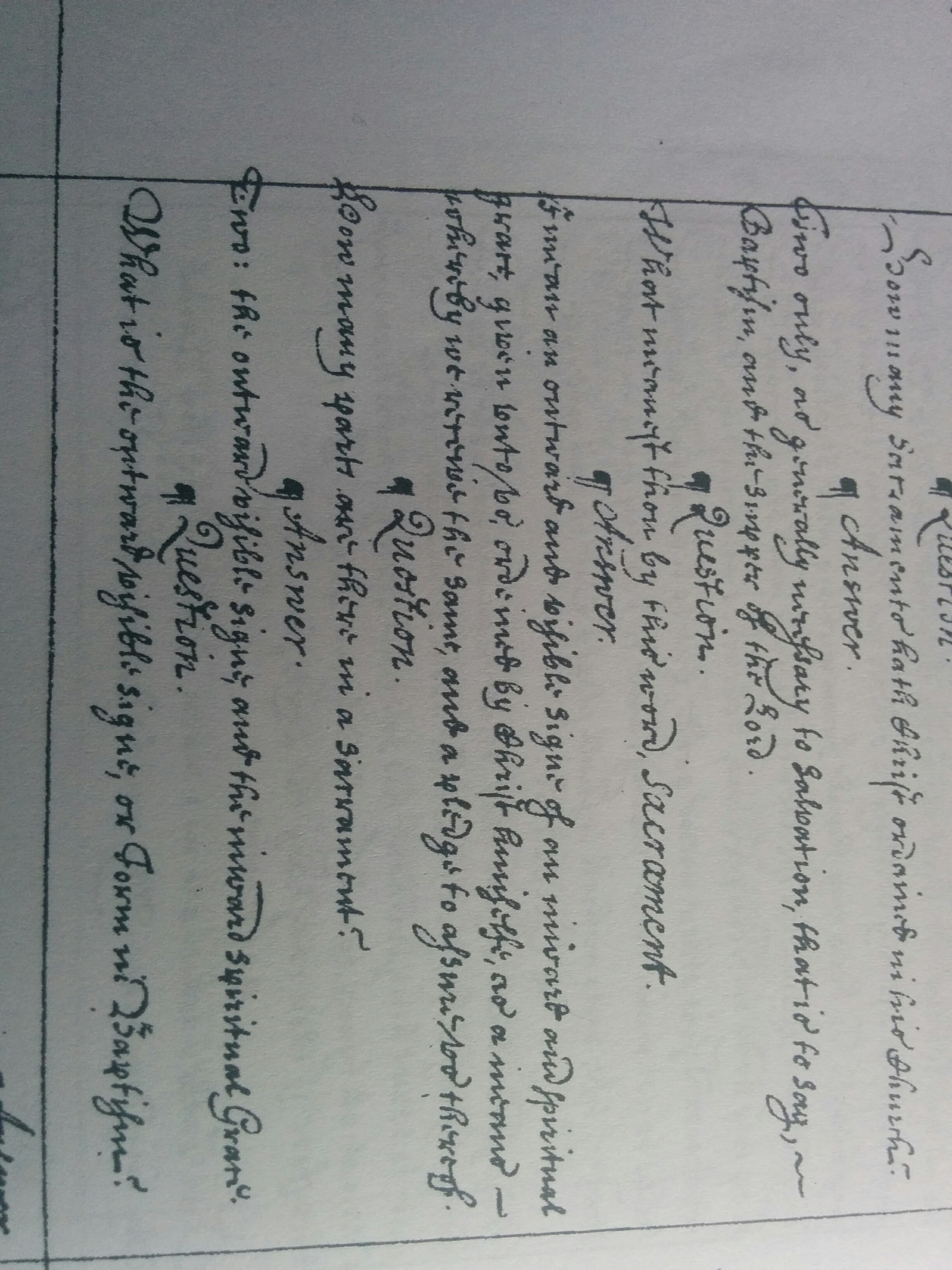
I have some bad news for you.  Your Book of Common Prayer is, well, illegal.  Something dastardly and manipulative has stolen important punctuation from the middle of your Catechism!  It is high time a commotion was caused over this theft.  Crack open your standard BCP and turn to the question “What meanest thou by this word sacrament” in the catechism and this is what the answer will say:

I mean an outward and visible sign of an inward and spiritual grace given unto us, ordained by Christ himself, as a means whereby we receive the same, and a pledge to assure us thereof.” 


This is what it should say:


I mean an outward and visible sign of an inward and spiritual grace, given unto us, ordained by Christ himself, as a means whereby we receive the same, and a pledge to assure us thereof.” 


Spot the difference? The comma has been stolen away after the word grace!  I swear I am not splitting hairs.  This is actually a much more serious issue than it might seem because it is both illegal and it undermines the clear Reformed stance of our Formularies with regard to the Sacraments.  Let us look at these two issues.


Firstly, the missing comma is arguably illegal because it breaches our trust.   The Book of Common Prayer is not an ordinary book.  I don’t just mean that it is extraordinary due to its captivating cadence, decisive doctrine, and soaring sentences (though this is certainly true).  Unlike nearly every other book the BCP is a legal document, it is attached to an Act of Parliament - namely the 1662 Act of Uniformity.  If there is ever a dispute over what the text of the BCP should be we need only recourse to this original document or the copies which were authenticated and signed by the Royal Commissioners and sealed by the Great Seal of England.  In all of these the comma after ‘grace’ is clearly present as this facsimilie of the BCP attached to the Act of Uniformity shows. 

bcp facsimile.jpg


When the comma was removed from printed versions ties very much into the second issue - the theology of the Catechism. The comma was stolen from our Catechism in the midst of the Oxford Movement and the pushing of Ritualism upon our Church in the mid 19th century.  It was first dropped in the prayer books printed by the Society for Promoting Christian Knowledge - a publisher quickly established as a ritualist stronghold. Around the same time The National Society published a teaching aid based on the Catechism and this contained explicit comment saying that there should be no comma after ‘grace’ and having a pause there obscures the “true sense.”  It is not hard to spot an agenda (and duplicity) at work here!


So why were the Ritualists trying to change the Catechism?  There were two reasons.  Firstly, the Ritualists were firm believers that the sacraments by definition always convey inward and spiritual grace - they work ex opere operato.  You do not need faith, you do not need to receive rightly; the simple act of receiving blessed sacraments will convey their benefits.  Baptism itself is salvific and the Lord’s Supper is always beneficial.  Secondly, the Ritualists wanted to teach that the sacraments - thinking especially of the Lord’s Supper - were actually sacrifices we offer to God.  It is thus important that it is the grace which is given to us and not the actual sign which is what we offer up to God.


None of this is the teaching of the English Reformers nor the official doctrine of the Church of England.  Article 25 teaches that the sacraments are not by definition conveyors of grace but rather it is only in those who “worthily receive the same they have a wholesome effect or operation” - only for these does the “sign of grace” become “effectual.”   Article 27 again emphasises that a person must receive baptism “rightly” whilst Article 28 speaks of the Lord’s Supper only benefitting those who “rightly, worthily, and with faith, receive…”.  The whole point of Article 29 is to make utterly indisputable that the Church of England sides with Reformed sacramental theology and not Lutheran sacramental theology by denying that wicked and faithless people do not in any sense receive Christ - let alone grace - when receiving the Lord’s Supper.  


The Reformed sacramentology of our Confession of Faith is fully supported by the correct wording of the Catechism.  Grammatically speaking - and I’m not trying to sound pretentious here - the participial adjective “given” must apply not to the “inward and spiritual grace” from which it has been immediately comma’d off but instead must apply to “outward and visible sign”.  Therefore, what has been given to us are the visible signs, namely bread, wine, and the waters of baptism.  These are not something we give to God - a sacrifice - but clearly something God has given to us - a sacrament.  


Likewise the Catechism does not teach that a Sacrament is “a sign and grace given to us” but rather it is “a sign of grace.”  The giving of grace is signified but is not essential nor intrinsic to there being a sacrament.  This is exactly what the Catechism’s answer goes on to explain - the “outward and visible sign” is “a means whereby we receive [an inward and spiritual grace], and a pledge to assure us thereof.”  It is a means but not a guarantee.  The sign is given as a pledge so that we know that as surely as we get wet in baptism or chew on bread in the Lord’s Supper just so surely has God promised to use these, when received in faith, to give us grace.


It is rather amazing how a single comma can change the entire theology of the Sacraments in the Catechism from a Romanist sacerdotal understanding to a Protestant and Reformed one.  There is no ambiguity though in the textual witness, every BCP should have a comma after ‘grace’ and the absence of it is underhanded.  I do not know if the printers at Cambridge and Oxford are aware of their error  but at the very least I would certainly recommend everyone get out a black pen and correct every BCP they own or their churches use.

Popular Posts