Showing posts with label BCP Commentary. Show all posts

Saturday, 15 December 2018

Still spilling ink over the Ornaments Rubric: the true history of its origin and interpretation.


Few paragraphs have elicited as much controversy and spilled ink as those of the "ornaments rubric."  They have even caused legal action and court cases up to the highest courts of the land.  People were jailed over their interpretation.   Even today the ornaments rubric is used to argue that it is proper and Anglican to wear sacerdotal vestments, namely the alb, stole, and chasuble.

With so much written on the matter trying to sum up the history and various facets of the matter is near impossible—especially for a person as verbose as I usually am!  That is, however, what I want to try and do here.


1549

               It begins in the second year of King Edward and the first Prayer Book of 1549.  This book addresses what ministers should wear in a few places.  It addresses it in detail at the end of the book under a section called "certain notes for the more plain explication and decent ministration of things contained in this book" as well as in the fourth rubric at the start of the Communion service and the first rubric at the end of it.  The dress of the minister according to these rubrics was to be, for priests, a surplice and hood except for during Holy Communion when an alb and either cope or chasuble.  Bishops were to always wear alb or surplice and chasuble or cope for all their services.  Tunicles are also mentioned.   In these rubrics the chasuble is called "vestment" which is why traditionally there has been a differentiation, particularly in England, between "vestments" which are sacerdotal and "robes" which are not and are essentially choir dress and the preaching gown.


1552
               In 1552 this all  changed and the minister was to wear surplice, scarf, and hood at every service whilst the bishop was to wear rochet and chimere. The use of albs and chasubles, as well as copes, was explicitly outlawed by the rubric at the start of Morning Prayer.


1559

               When Elizabeth came to the throne the question of what was to be done was raised once more.  Was it to be the 1549 Prayer Book or the 1552?  The answer was simple. Elizabeth brought back the 1552  with the Act of Uniformity.  Strictly speaking there was no "Elizabethan Prayer Book" only the 1552 book with three additional provisions: namely the addition of two sentences during the administration of Communion, the addition of certain readings, and changes to the Litany. 

               It is important to bear in mind that the Act of Uniformity was actually part of the Prayer Book, it came before it but they were one document.  In the second chapter of the Act of Uniformity it is decreed that the "order and form as is mentioned in the said Book, so Authorised by Parliament in the said fifth and sixth years of the Reign of King Edward the Sixth" was to be used in every ministration. At this point it seems simple that the 1552 rubric outlawing albs and chasubles is the end of the matter.

               Things are rarely so simple.  The Act of Uniformity also had two sections which bear on this matter.

"25.  Provided always, and be it enacted, that such Ornaments of the Church and of the Ministers thereof, shall be retained, and be in use, as was in this Church of England, by Authority of Parliament, in the second year of the reign of Edward the Sixth, until other Order shall be therein taken by the Authority of the Queens' majesty, with the Advice of her Commissioners appointed and authorised under the great seal of England for causes ecclesiastical, or of the Metropolitan of this Realm.
26. And also that if there shall happen any contempt or irreverence to be used in the ceremonies of rites of the church, by the misusing of the orders appointed in this book, the Queen's majesty may, by the like advice of the said commissioners or Metropolitan, ordain and publish such further ceremonies or rites as may be most for the advancement of God's glory, the edifying of his church, and the due reverence of Christ's holy Mysteries and Sacraments."

What are we to make of this seeming contradiction?  Are the alb and chasuble to be "retained, and be in use" or does the ornaments rubric of 1552 and the second chapter of the Act of Uniformity which outlaws  these actually stand as authoritative?

The obvious question when trying to understand this is simply to ask "what did the writer of the Act say it meant."  Archbishop Sandys made clear that in fact the words "retained, and be in use" do not mean what they seem to us today to mean. Rather they mean simply that the albs and chasubles of the churches are not to be destroyed until further command and direction was forth coming. 

"Our gloss upon this text is  that we shall not be forced to use them, but that others in the meantime shall not convey them away; but that they may remain for the Queen"  Archbishop Sandys to Parker (remain for the Queen being a reference to their future confiscation and sale to help support the much indebted crown -- much as Henry and Edward had done with church finery before her!)

This is in keeping with the iconoclasm of the Anglican Reformers which likewise forbade private individuals from destroying idols in their churches and instead demanded that they wait for the magistrate to carry this out.  Things being done in an orderly way was important to the Anglican Reformers.

In addition, both sections make clear that further instruction is going to be given, at the least on what to do with vestments.  When this instruction came it would overrule and fulfil the provisions of the Act of Uniformity and be binding.  In due course such "other order" did indeed come forth.

But hold on! Things get even more complicated! 

The Act of Uniformity restored the 1552 Prayer Book with only three changes (the additional sentences on reception and addition of certain readings as well as changes to the Litany).  The 1559 Book of Common Prayer with the attached Act of Uniformity was a legal and unchangeable document. It was an Act of Parliament. And yet, illegally, it was changed at the printers! 

In the printed book of 1559, not the official and authoritative book, the 1552 Ornaments rubric outlawing the alb and stole and cope was changed to read:

"And here is to be noted, that the Minister at the time of Communion, and at all other times in his ministration, shall use such ornaments in the Church, as were in use by authority of parliament, in the second year of the reign of King Edward the Sixth according to the Act of Parliament set in the beginning of this book."

This rubric had absolutely no authority in law and was omitted in the Latin Prayer Book of 1560.  It was simply a quick pointer the Act of Uniformity which was at the start of the book— and yet one which is in error as the Act of Uniformity does not actually say "shall use such ornaments" but "shall retain, and be in use", nor does it say "as were in use" but "as was in this church", and it omits the promise of additional instruction.

Was this sneaky rubric an indication of how people understood the Act? Did people actually think that the 1549 vesture was to be used not the 1552? 

Most certainly not.  

In the same year as this illegal printed rubric is found the Injunctions of Queen Elizabeth were published and commissioners sent all over the nation to enforce obedience to them and compel subscription.  Items 30 and 47 of these injunctions demanded respectively that:

"30.... [all ministers] both in the church and without.... shall use and wear such seemly habits, garments, and such square caps as were most commonly and orderly received in the latter year of the reign of King Edward the Sixth..."
"47.  That he churchwardens of every parish shall deliver unto our visitors and inventories of vestments, copes, and other ornaments, plate, books, and specially of grayles, vouchers, legends, processionals, hymnals, manuals, poruasses, and such like appertaining to the church"

The injunctions clearly enforced the clerical wear of the 1552 and by law required all parishes to hand over for destruction or sale their vestments and other Roman ornamentation. 


1566

The unwillingness of the Puritans renewal movement to wear the surplice enjoined by the Injunctions and Act of Uniformity led to additional measures being taken in 1566.  To resolve this the 1566 Advertisements were introduced.  These are the official "other order" promised in the Act of Uniformity.  These Advertisements demanded the surplice be worn at every service by the minister except at Cathedrals and Collegiate Churches during Holy Communion where the cope was to be worn by not only the celebrant but also the gospeller and epistoller.

From this point onwards the regular Visitations of the bishops in their diocese referred back to the Injunctions to ensure vestments were destroyed and to the Advertisements that a surplice and it alone (except the cope at Cathedrals etc. though this part never seems to have been enforced) be worn for every service. 


1604

Finally, in 1604 the Church of England got new Canon Law.  The Canons reinforced the required dress of the Advertisements with some minor changes—the cope was now only for principal feast days not every sabbath, non-graduates could wear a tippet/preaching scarf.

Even under Laud this status quo is clearly seen in his Visitation Articles of 1628:

"Whether doth your minster wear the surplice while he is saying your public prayers, and administering the Sacrament, and a hood according to his degree of the University: Whether there be in your parish, who are known or suspected, to conceal or keep hid in their homes any Mass books, Breviaries, or other books of Popery or superstition, or any chalice, copes, vestments, alb, or other ornaments of superstition, uncancelled, or undefaced, which is to be conjectured they keep for a day as they call it."


1662

               In 1662 the illegal rubric of 1559 was modified to read :

"And here is to be noted that such ornaments of the Church, and of the Ministers thereof, at all times of their Ministration, shall be retained, and be in use, as were in this Church of England by the authority of Parliament, in the second year of the reign of King Edward the Sixth."

This change is important. Rather than a poor paraphrase of the Act of Uniformity this rubric is an exact quotation from the Act except the updated grammar of "were" for "was".  The 1662 Prayer Book continued to have the Act of Uniformity as the first item in the list of contents—in other words the Act was still part of the Prayer Book and thus it was seen as obvious that this short quotation was intended to simply point back to and mean exactly the same as the Act at the start of the book.  That Act, if you recall, did not enjoin the use of the 1549 vestments but merely that they be retained till the commissioners came along to dispose of them under the Injunctions and that the "other order" was given in the Advertisements which demanded a surplice only.  The plain reason for not including the words "until other order is taken" in the short rubric is that such order had already been taken and was already enshrined in not only statute law but canon law and was being enforced by every bishop of the land.

The visitations of every single bishop in 1662 except Sterne of Carlisle, Roberts of Bangor, Fearne of Chester, and Warner of Rochester (as well as the See of Sodor and Man which was vacant from early 1662 till 1665) explicitly demand the wearing of the surplice at all times of ministry.  The only reason we don't have information on them is  that there are no remaining copies of their articles of visitation but it would be absurd to suppose they differed from all the other bishops and were openly defying canon and state law, indeed we do have such clear instruction from the bishops who followed them. The canons of 1604 were likewise reprinted in 1660 and again in 1662 with bishops such as Cosin, Henchmen, and Ironside requiring a copy to be in every parish.  Quotations and excerpts from all of these can be found in J.T. Tomlinson's "Collected Tracts of Ritual" in the Tract "Additional Evidence respecting the Ornaments Rubrics of 1662."


19th Century

It was not till the 1800's that anyone even thought to try and bring back the obsolete vestments on the basis of the rubric.  In doing so they immediately found themselves in court and the truth of the rubric subject to scrutiny.

The most significant court ruling, and the definitive one, was that of the Folkestone Ritual Case 1878. This court case ruled that:
-        The rubric is subordinate to the full Act of Uniformity from which it is a quotation. The 1559 Act of Uniformity, as part of the 1662 Book of Common Prayer, was still law.
-        What matters is whether "other order" was taken as promised in the Act of Uniformity.
-        "Other order" was taken in 1566 with the Advertisements.
-        "The authority of Parliament in the second year of King Edward the Sixth" excludes anything prior to 1549 and anything not explicitly prescribed in 1549 (which is besides the point given the above but interesting nonetheless and clearly rules out vast swathes of Roman ritualistic dress, utensils, and ornamentation which are commonly seen in Anglo-Catholic Churches today.)

Summary
Where does this fascinating history leave us? 

-        The 1559 Prayer Book was simply the restoration of the 1552 and the ornaments rubric in it was illegal. The Act of Uniformity, to which the rubric was a poor paraphrase, said that such vestments were not to be destroyed and "other order" would be shortly given.

-        The 1559 Injunctions demanded the defacing and destruction of all vestments (or their confiscation to sell and help alleviate public debt)  so clearly they were not intended to be used (see also Sandys gloss) and official further instruction was given in 1566 which enforced the use of the surplice at all services.

-        The official 1662 Prayer Book has the Act of Uniformity as the first item on the list of contents. The illegal rubric was replaced by an exact quotation from the act but did not include the note of "other order" because it was already taken and enforced by state law and the restored 1604 canons.  Given this context the ornaments rubric of 1662 does not allow the vestments and ornaments of 1549.

-        All persons involved in the 1662 revision and every bishop we know at the time demanded surplice only and recognised not only canon law and the 1566 Advertisements (the "other order promised) but also the injunctions and of Elizabeth.

-        At no point from 1552 onwards was it ever seriously considered or even imagined that the 1549 Vestments were to be used or even that their use was legal and possible.  That is until the 1800's at which point the courts ruled that such vestments were not legal and had never been since at least 1566 - but were clearly not used or countenanced from 1559 onwards given the Injunctions.

-    The dress of the Anglican minister from 1552 onwards was distinctive and Reformed. It taught that the minister was to be learned and his primary role was to proclaim the gospel, teach the Scriptures, and rebuke error. To this end the tippet and hood alongside academic square cap were required of ministers at all times of their ministry whilst the surplice, a non-sacerdotal and not even uniquely clerical garment, was worn to distinguish the minister at times of service. During sermons the academic gown was to be worn instead of the surplice though to emphasise the nature of teaching. For more on the distinctive dress of Anglican ministers and its importance see:

A little faithfulness: Anglican robes and heritage

A Plea for Anglican Distinctives

Friday, 7 October 2016

The Missing Comma in your BCP

I have some bad news for you.  Your Book of Common Prayer is, well, illegal.  Something dastardly and manipulative has stolen important punctuation from the middle of your Catechism!  It is high time a commotion was caused over this theft.  Crack open your standard BCP and turn to the question “What meanest thou by this word sacrament” in the catechism and this is what the answer will say:

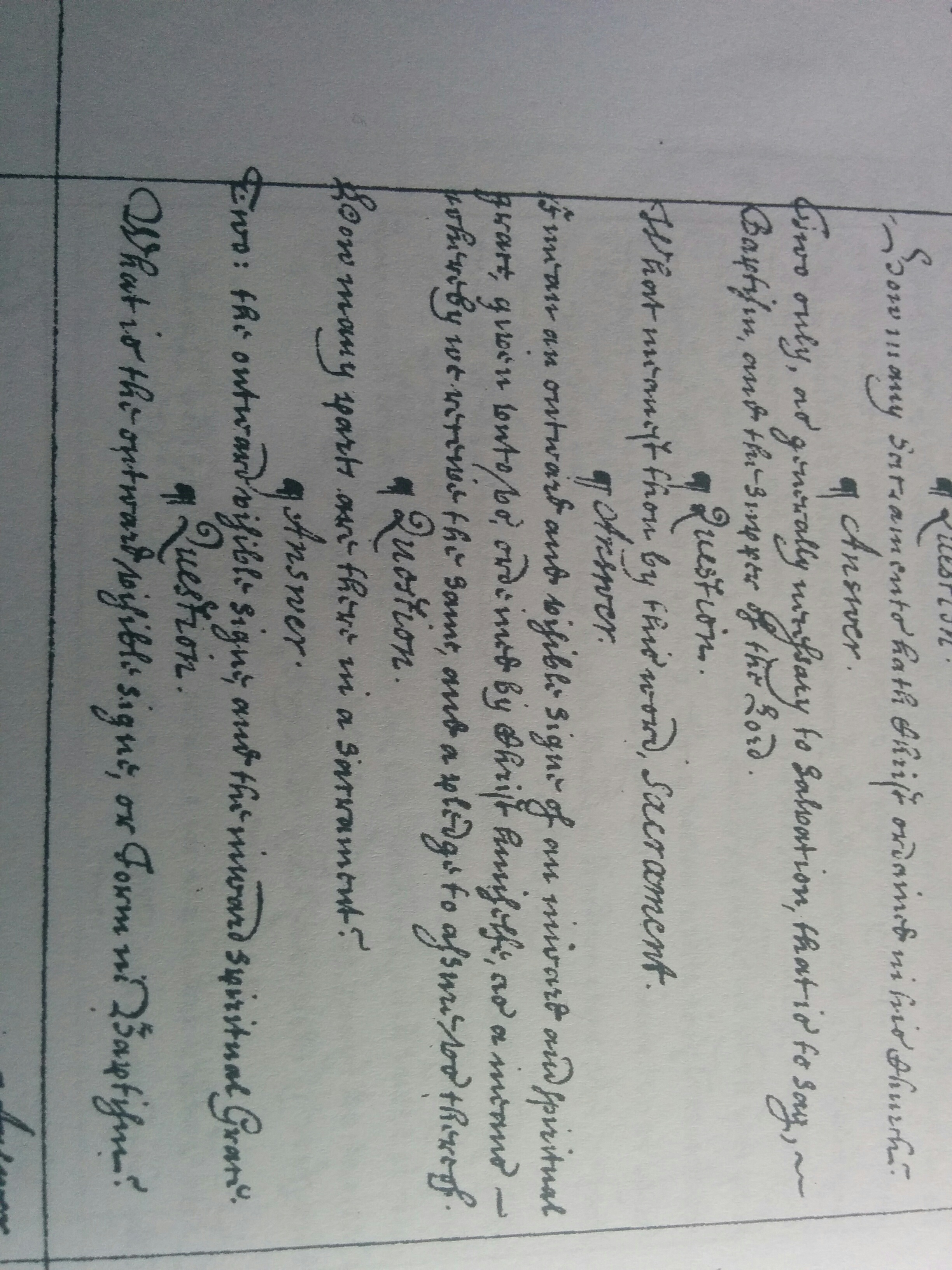
“I mean an outward and visible sign of an inward and spiritual grace given unto us, ordained by Christ himself, as a means whereby we receive the same, and a pledge to assure us thereof.” 


This is what it should say:


“I mean an outward and visible sign of an inward and spiritual grace, given unto us, ordained by Christ himself, as a means whereby we receive the same, and a pledge to assure us thereof.” 


Spot the difference? The comma has been stolen away after the word grace!  I swear I am not splitting hairs.  This is actually a much more serious issue than it might seem because it is both illegal and it undermines the clear Reformed stance of our Formularies with regard to the Sacraments.  Let us look at these two issues.


Firstly, the missing comma is arguably illegal because it breaches our trust.   The Book of Common Prayer is not an ordinary book.  I don’t just mean that it is extraordinary due to its captivating cadence, decisive doctrine, and soaring sentences (though this is certainly true).  Unlike nearly every other book the BCP is a legal document, it is attached to an Act of Parliament - namely the 1662 Act of Uniformity.  If there is ever a dispute over what the text of the BCP should be we need only recourse to this original document or the copies which were authenticated and signed by the Royal Commissioners and sealed by the Great Seal of England.  In all of these the comma after ‘grace’ is clearly present as this facsimilie of the BCP attached to the Act of Uniformity shows. 

bcp facsimile.jpg


When the comma was removed from printed versions ties very much into the second issue - the theology of the Catechism. The comma was stolen from our Catechism in the midst of the Oxford Movement and the pushing of Ritualism upon our Church in the mid 19th century.  It was first dropped in the prayer books printed by the Society for Promoting Christian Knowledge - a publisher quickly established as a ritualist stronghold. Around the same time The National Society published a teaching aid based on the Catechism and this contained explicit comment saying that there should be no comma after ‘grace’ and having a pause there obscures the “true sense.”  It is not hard to spot an agenda (and duplicity) at work here!


So why were the Ritualists trying to change the Catechism?  There were two reasons.  Firstly, the Ritualists were firm believers that the sacraments by definition always convey inward and spiritual grace - they work ex opere operato.  You do not need faith, you do not need to receive rightly; the simple act of receiving blessed sacraments will convey their benefits.  Baptism itself is salvific and the Lord’s Supper is always beneficial.  Secondly, the Ritualists wanted to teach that the sacraments - thinking especially of the Lord’s Supper - were actually sacrifices we offer to God.  It is thus important that it is the grace which is given to us and not the actual sign which is what we offer up to God.


None of this is the teaching of the English Reformers nor the official doctrine of the Church of England.  Article 25 teaches that the sacraments are not by definition conveyors of grace but rather it is only in those who “worthily receive the same they have a wholesome effect or operation” - only for these does the “sign of grace” become “effectual.”   Article 27 again emphasises that a person must receive baptism “rightly” whilst Article 28 speaks of the Lord’s Supper only benefitting those who “rightly, worthily, and with faith, receive…”.  The whole point of Article 29 is to make utterly indisputable that the Church of England sides with Reformed sacramental theology and not Lutheran sacramental theology by denying that wicked and faithless people do not in any sense receive Christ - let alone grace - when receiving the Lord’s Supper.  


The Reformed sacramentology of our Confession of Faith is fully supported by the correct wording of the Catechism.  Grammatically speaking - and I’m not trying to sound pretentious here - the participial adjective “given” must apply not to the “inward and spiritual grace” from which it has been immediately comma’d off but instead must apply to “outward and visible sign”.  Therefore, what has been given to us are the visible signs, namely bread, wine, and the waters of baptism.  These are not something we give to God - a sacrifice - but clearly something God has given to us - a sacrament.  


Likewise the Catechism does not teach that a Sacrament is “a sign and grace given to us” but rather it is “a sign of grace.”  The giving of grace is signified but is not essential nor intrinsic to there being a sacrament.  This is exactly what the Catechism’s answer goes on to explain - the “outward and visible sign” is “a means whereby we receive [an inward and spiritual grace], and a pledge to assure us thereof.”  It is a means but not a guarantee.  The sign is given as a pledge so that we know that as surely as we get wet in baptism or chew on bread in the Lord’s Supper just so surely has God promised to use these, when received in faith, to give us grace.


It is rather amazing how a single comma can change the entire theology of the Sacraments in the Catechism from a Romanist sacerdotal understanding to a Protestant and Reformed one.  There is no ambiguity though in the textual witness, every BCP should have a comma after ‘grace’ and the absence of it is underhanded.  I do not know if the printers at Cambridge and Oxford are aware of their error  but at the very least I would certainly recommend everyone get out a black pen and correct every BCP they own or their churches use.

Friday, 23 September 2016

Anglicanism and Salvation in Christ Alone.

My second blog post for Church Society - what do the Historic Formularies of the Church of England teach about Salvation in Christ alone and who are the only people they anathematise? Click here to find out!

Friday, 9 September 2016

God and Nature in the Book of Common Prayer

My first guest post on the Church Society blog! What does the Book of Common Prayer say about God and His control of nature? Click here to find out!


Wednesday, 19 August 2015

The duty and calling of ministers - part 3


3.  Qualifications for the Work.
       Forasmuch then as your office is both of so great excellency and of so great difficulty,
you see with what great care and study you ought to apply yourselves,
       as well that you may show yourselves dutiful and thankful to that Lord,
                 who has placed you in so high a dignity;
      and also to beware that you personally neither offend,
      nor be the cause of others offending.


"About eating food offered to idols, then, we know that “an idol is nothing in the world,” and that “there is no God but one.” For even if there are so-called gods, whether in heaven or on earth—as there are many “gods” and many “lords”—
yet for us there is one God, the Father.
All things are from Him,
and we exist for Him.
And there is one Lord, Jesus Christ.
All things are through Him,
and we exist through Him.
However, not everyone has this knowledge. In fact, some have been so used to idolatry up until now that when they eat food offered to an idol, their conscience, being weak, is defiled. Food will not make us acceptable to God. We are not inferior if we don’t eat, and we are not better if we do eat. But be careful that this right of yours in no way becomes a stumbling block to the weak. For if someone sees you, the one who has this knowledge, dining in an idol’s temple, won’t his weak conscience be encouraged to eat food offered to idols? Then the weak person, the brother for whom Christ died, is ruined by your knowledge. Now when you sin like this against the brothers and wound their weak conscience, you are sinning against Christ. Therefore, if food causes my brother to fall, I will never again eat meat, so that I won’t cause my brother to fall."  1 Corinthians 8.4-13

"Then they prayed, “You, Lord, know the hearts of all; show which of these two You have chosen" Acts 1.24


Once again we are reminded that the office of priest is a high calling.  Indeed it is a 'great excellency' — the kind of phrase usually reserved for royalty, heads of government such as Presidents, and international judges.  As God's minister we should carry ourselves like, and in our life be as exacting as, those in the world who earn the title 'excellency.'  This will be difficult, and The Ordinal has no shame in speaking that plain and simple truth.  Ministry is greatly difficult and there is no way around that.  If you are not finding ministry difficult then it is likely because you are either not doing it properly or you fail to grasp what it is you are called to not only do but what you are called to be.

That we must apply ourselves with all care and study goes without saying but what this means practically will be covered later.   In any case The Ordinal clearly expects the way we study and apply ourselves to our ministry will be such that any onlooker would recognise immediately in us a person who is both most dutiful and professional in their work and yet also eminently thankful for all the blessings and challenges God graces them with.   This thankfulness flows from a simple fundamental truth which both haunts and buoys those in ministry — this calling was not their choice, it was God's calling and His choosing.  Whilst it may be true that the church on earth acknowledges and endorses a minister in their calling the church does not give it or maintain it - nor can it remove it.  As the first question in the Public Examination makes clear, a person is called above all else by God Himself and thus his spiritual authority flows from that simple truth.  The reason that none of the Reformers up till Laud, and even many afterwards, did not have an issue with inviting non-episcopally ordained clergy to minister in the Church of England without 're-ordination' is simply because it was God who gave authority and churches, whether episcopal or not, merely publicly recognise and legally licence it.  God has placed us in this ministry, let us not forget or sully it.

The final clause is the need for ministers to beware against offending any.  This clearly cannot mean offending by preaching the gospel which is inherently offensive to human nature.  Instead it refers to life and manners, how we act, speak, and relate others, what we do and what we don't do.  Again this is a careful balancing act, but the example given by Paul regarding not offending 'weaker brothers' who could be enticed to sin by acting against their conscience is of utmost importance.  Paul goes so far as to say that if we needlessly endanger, offend, or cause the stumbling of a fellow Christian we are guilty of sin against Jesus Christ Himself.  This should have ramifications on how ministers relate to alcohol, gambling, television, language, and even dress.   Many Christians wander through life oblivious to the effects of their words and actions.  As ministers we have a duty not to be oblivious.  We have a duty to be not only reactionary to causing such a person to stumble but proactively anticipatory of even the slim possibility of causing such stumbling.  Ultimately, as God's ambassadors, we must put the needs and holiness of others before our own freedoms and desires.     


Do you grasp what an excellency you have been given and does this daily encourage and bolster your efforts to live up to your calling?

Do you truly recognise the difficulty of your ministry?  How do you react to such difficulty?

What does it mean for you that God personally chose you for ministry in His church?   How does this truth change you?

Looking at what Paul says about sinning against Christ by leading others to stumble, what in our society today might ministers be doing which Paul would question?

Where might you be causing offence or unnecessary stumbling?


a) Prayer for the Holy Spirit.
However, you cannot have a mind and will to do this by yourselves;
         for that will and ability is given by God alone.
Therefore you ought, and have need, to pray earnestly for His Holy Spirit.


"When he was in distress, he sought the favour of Yahweh his God and earnestly humbled himself before the God of his ancestors."  2 Chronicles 33.12

"Elijah was a man with a nature like ours; yet he prayed earnestly that it would not rain, and for three years and six months it did not rain on the land."  James 5.17

"Search for the Lord and for His strength; seek His face always." 1 Chronicles 16.11

"Wisdom and strength belong to God; counsel and understanding are His." Job 12.13

"He will also strengthen you to the end, so that you will be blameless in the day of our Lord Jesus Christ." 1 Corinthians 1.18

"For we don’t want you to be unaware, brothers, of our affliction that took place in Asia: we were completely overwhelmed—beyond our strength—so that we even despaired of life." 2 Corinthians 1.8

"I pray that He may grant you, according to the riches of His glory, to be strengthened with power in the inner man through His Spirit,"  Ephesians 3.16

"I am able to do all things through Him who strengthens me."  Philippians 4.13

"May you be strengthened with all power, according to His glorious might, for all endurance and patience, with joy" Colossians 1.11

"I labour for this, striving with His strength that works powerfully in me." Colossians 1.29

"But the Lord is faithful; He will strengthen and guard you from the evil one." 2 Thessalonians 3.3

"If anyone speaks, it should be as one who speaks God’s words; if anyone serves, it should be from the strength God provides, so that God may be glorified through Jesus Christ in everything. To Him belong the glory and the power forever and ever. Amen." 1 Peter 4.11

"So when they arrest you and hand you over, don’t worry beforehand what you will say. On the contrary, whatever is given to you in that hour—say it. For it isn’t you speaking, but the Holy Spirit."  Mark 13.11

"But the Counsellor, the Holy Spirit—the Father will send Him in My name—will teach you all things and remind you of everything I have told you." John 14.26

"For our gospel did not come to you in word only, but also in power, in the Holy Spirit, and with much assurance. You know what kind of men we were among you for your benefit," 1 Thessalonians 1.5

"Guard, through the Holy Spirit who lives in us, that good thing entrusted to you." 2 Timothy 1.14

"I pray that the God of our Lord Jesus Christ, the glorious Father, would give you a spirit of wisdom and revelation in the knowledge of Him." Ephesians 1.17

"Devote yourselves to prayer; stay alert in it with thanksgiving." Colossians 4.2

"At the same time, pray also for us that God may open a door to us for the message, to speak the mystery of the Messiah, for which I am in prison," Colossians 4.3

All that has so far been laid out and all that will follow is quite bluntly an impossible standard.  No human excepting Jesus could ever even come close to it.  That is not to say we should not strive to do and be all we can for the glory of our Lord, but we must also be humble.  We must never, ever, let pride infect our mind or seep its rancid sewerage into our veins.  The reality is that without God at work within us not only would be fall miserably short of achieving any of our calling but we would not even have the basic and fundamental desire or will to do so in the first place.  A holy discontent with ones holiness and ministry is a sure sign of the Lord at work. 

We must model in our lives and teaching a humility which makes plain that our strength is weak and we can only go on through God's strength; that our minds are feeble and stupid such that we can only teach through God's gift of wisdom; that our hearts are so weak and fearful, so slothful and selfish that the only way we can lead God's people is by His Holy Spirit giving us a new heart and a new mind.  Not only must we model this we must actually live it!  We need to be on our knees each day praying before all things for God to be at work within us.  We must be constantly casting down our weaknesses and failures and calling on God to redeem them through His blood and power.

The amazing thing is, our God is so loving and generous that when we come to Him with a broken and contrite heart, with humility and empty hands, He gives us more than we could ever imagine or hope for.

How does the fact that you can never do enough or be good enough, let alone fulfil the life laid out in this exhortation, make you feel?  How should you respond?

How do you kill pride and selfish self-serving attitudes?

How practically can you model an utter dependence on God?

Do you truly believe that God will give you  'the will and the way' in your ministry?


b) Study of the Scriptures.
And seeing that you cannot by any other means accomplish
                  the doing of so weighty a work, pertaining to the salvation of man,
                                        but with doctrine and exhortation
                                                             taken out of the holy Scriptures,
                                           and with a life agreeable to the same;
                 consider how studious you ought to be in reading and learning the Scriptures,
                 and in framing the manners both of yourselves,
                 and of them that specially pertain to you,
                 according to the rule of the same Scriptures:
                               and for this self-same cause,
                                 how you ought to forsake and set aside (as much as you may) all worldly
                                  cares and studies.


"But as for you, continue in what you have learned and firmly believed. You know those who taught you, and you know that from childhood you have known the sacred Scriptures, which are able to give you wisdom for salvation through faith in Christ Jesus. All Scripture is inspired by God and is profitable for teaching, for rebuking, for correcting, for training in righteousness, so that the man of God may be complete, equipped for every good work." 2 Timothy 3.14-17

"Do your best to present yourself to God as one approved, a worker who has no need to be ashamed, rightly handling the word of truth." 2 Timothy 2.15

"Every word of God is pure;
He is a shield to those who take refuge in Him.
Don’t add to His words,
or He will rebuke you, and you will be proved a liar" Proverb 30.5-6

"so My word that comes from My mouth
will not return to Me empty,
but it will accomplish what I please
and will prosper in what I send it to do.” Isaiah 55.11

"I have stored up your word in my heart, that I might not sin against you." Psalm 119.11

"This Book of the Law shall not depart from your mouth, but you shall meditate on it day and night, so that you may be careful to do according to all that is written in it. For then you will make your way prosperous, and then you will have good success." Joshua 1.8

"Do not be conformed to this world, but be transformed by the renewal of your mind, that by testing you may discern what is the will of God, what is good and acceptable and perfect." Romans 12.2

"How can a young man keep his way pure? By guarding it according to your word." Psalm 119.9

"For the word of God is living and active, sharper than any two-edged sword, piercing to the division of soul and of spirit, of joints and of marrow, and discerning the thoughts and intentions of the heart." Hebrews 4.12

"My people are destroyed for lack of knowledge; because you have rejected knowledge, I reject you from being a priest to me. And since you have forgotten the law of your God, I also will forget your children." Hosea 4.6

"But his delight is in the law of the Lord, and on his law he meditates day and night."  Psalm 1.2

"This saying is trustworthy: “If anyone aspires to be an overseer, he desires a noble work.” An overseer, therefore, must be above reproach, the husband of one wife, self-controlled, sensible, respectable, hospitable, an able teacher, not addicted to wine, not a bully but gentle, not quarrelsome, not greedy— one who manages his own household competently, having his children under control with all dignity. (If anyone does not know how to manage his own household, how will he take care of God’s church?) He must not be a new convert, or he might become conceited and fall into the condemnation of the Devil. Furthermore, he must have a good reputation among outsiders, so that he does not fall into disgrace and the Devil’s trap." 1 Timothy 3.1-7


When God gives us the will and ability to fulfil our calling the ways in which it is fulfilled are the next things to be considered.  How should a minister spend their time in order to serve their Lord to the best of their ability?  What methods should a minister use to train themselves in righteousness and virtue that they may be examples to their flocks?  Above all things, the resounding answer of our reformers is simple: hear, read, mark, learn, and inwardly digest the Holy Scriptures.  A minister of God is to be a person of the Bible.  When Saint Paul was in prison it was not food or clothes that were most important to him, the first place was given to his 'scrolls' - that is his Bible.
 
What the Church of England teaches about Scripture will be examined further when looking at the Public Examination but that it is the foundation and wellspring of all a minister should be is clear from the extensive treatment in this exhortation. 

The means of accomplishing the salvation of many and the life of ministry is primarily through doctrine and preaching.  In the view of the Reformers right doctrine leads to right living.  Good preaching leads to changed lives and transformed morals.  Every minister should be a theologian, every minister should care and be passionate about doctrine.  Every minister should hold preaching as their highest calling.  Importantly though, all this doctrine and teaching and preaching must come from one place above anywhere else — the Bible.  Anything which is not from the Bible or cannot be supported by it is not to be taught as necessary to salvation.  Likewise when looking on how a minister should order their lives the exhortation points us in the direction of Scripture to find the answer.  In a world which constantly devalues Scripture and relativises it, as only a post-modern mindset could, ministers should be ever appealing to Scripture for all things both great and small.

Given ministers must teach biblical doctrine and live Biblical lives it is no wonder we are told ministers should 'studiously' read and learn the Scriptures.  Ministers are to be perpetual and eternal students sitting beneath God's word and absorbing its wisdom, truth, and power through careful exegesis, prayerful seeking, and humble submission.  This is a challenging task for any Christian, especially the last part, but it is vital to a healthy and wholesome ministry.  There is simply no way around the fact that the Anglican view of ministry involves much time spent in the study delving into the wondrous and glories depths of the mysteries of God revealed through the pages of the Bible.

This study should lead to practical and externally recognisable changes in life and manners.  Our lives, saturated in Scripture, should not make sense to the world around us.  Our lives should be models of Biblical holiness and truth to those seeking it.  But for ministers the buck doesn't stop at our own door — we must likewise fashion the lives of our families and even those committed to our charge.  Paul tells us that marriage is an image to the world of the love of Christ for the Church.  If you can't run a household decently, Paul tells Timothy, you shouldn't be running a church.  In the Bible every man is the pastor of his family, only the best family pastors should take on the role of pastoring the wider body of Christ.

Perhaps the most challenging aspect of the exhortation is that the study of Scripture should so consume our lives that we lay aside and count as worthless the cares of the world and the studies it would call us to pursue.  Thankfully the exhortation graciously recognises that we can only do this as far as we are able (or God allows?) and thus we are not to decry having a hobby or despise all secular pleasure.  But. nonetheless, such things must most definitely be second place in our lives.  At best we should use them to recharge our batteries and inform our ministry as much as may be needed and no more. 

You may be wondering what this practically means.  Well, thankfully, the Reformation canons of the Church were more than clear in explaining such things:

"No ecclesiastical person shall at any time, other than for their honest necessities, resort to any taverns or alehouses, neither shall they board or lodge in any such places.  Furthermore, they shall not give themselves to any base or servile labour, or to drinking or riot, spending their time idly by day or by night, playing at dice, cards, or tables, or any other unlawful games: but at all times convenient they shall hear or read somewhat of the Holy Scriptures, or shall occupy themselves with some other honest study or exercise, always doing the things which appertain to honesty, and endeavouring to profit the church of God; having always in mind that they ought to excel all others in purity of life, and should be examples to the people to live well and christianily, under pain of ecclesiastical censures, to be inflicted with severity according to the qualities of their offences."  The Canons of 1603 75.

"The sober, grave and exemplary conversation of all those that are employed in the administration of holy things being of great avail for the furtherance of piety, it hath been the religious care of the Church of England strictly to enjoin on all and every one of her clergy, a pious, regular and inoffensive demeanour, and to prohibit all loose and scandalous carriage by severe censures to be inflicted upon such delinquents as appears by the 74th and 75th canons of 1603 provided to this purpose.
For the more effectual success of which pious and necessary care this present synod straitly charges all clergymen in this church that setting before their eyes the glory of God, the holiness of their calling and the edification of the people committed to them, they carefully avoid all excess and disorder, and that by their Christian and religious conversation they shine forth as lights unto others in all godliness and honesty." Canons of 1640 10.1-2

Whilst these canons are no longer in force and have been relaxed beyond all recognition, they are the kind of things this exhortation is talking about - and all ministers should be greatly challenged by such canon laws.


How important do I think right and biblical doctrine is?  How do I ensure my teaching is thoroughly biblical?

Is my life recognisable as one lived by and to biblical standards?  How often do I evaluate my life by the bible and do I have any systems in place to ensure I do?

How much time do I spend studying Scripture?  Is this enough or not? 

How high is studying Scripture on my list of ministry priorities daily, weekly, monthly, annually?

When I don't like what Scripture says am I willing to humbly submit to it?

How am I actively fashioning the life of my family by biblical teaching and standards?

What cares and studies of the world do I occupy my time with?  Is  this more than I should, where is the healthy balance?

Are there any 'worldy things' I do or take part in which fall short of the exemplary life I am called to lead (which should have an eye to making sure no-one should stumble by my example)


Popular Posts